
At a glance
A practical course where students learn how robots and automated systems work. Students design, build and program systems that combine electronics, mechanics and control software to solve real problems.
This course is a good choice for students who:
- enjoy making things, tinkering, and solving problems step-by-step
- are interested in coding, electronics, robotics, engineering or automation
- like building and improving prototypes through testing
About this course
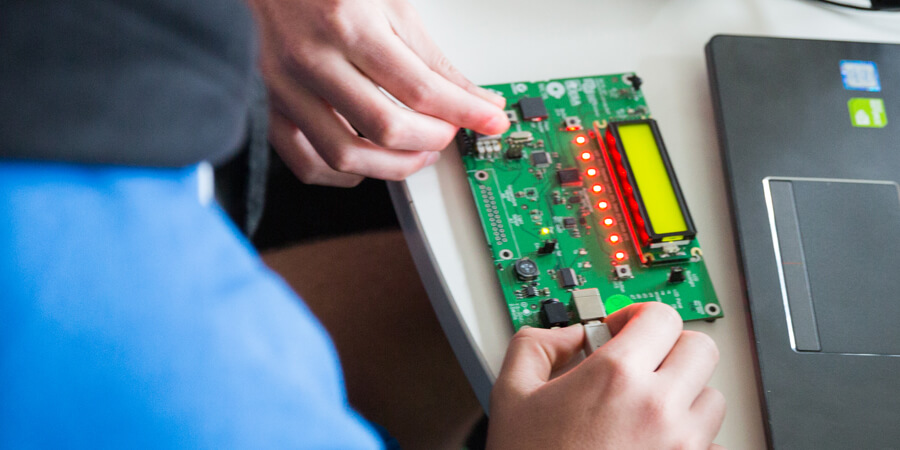
Robotics and Mechatronics explores automation and physical computing. Students learn core ideas in electronics and mechatronics, then use microcontrollers to drive electrical circuits and mechanical systems. Students apply the design process to build real systems, including programming control software for autonomous and manual control, and adjusting for unexpected changes in data and inputs.
Pathways
This course can support pathways into areas such as:
- engineering and applied technologies
- information technology and programming
- electronics, automation and technical trades pathways
- science and innovation-focused study pathways
Units in this course
Students complete 2 units for a Minor or 4 units for a Major.
Building and Programming Circuits
This unit introduces the components of electronics and how to design and build electronic systems safely.
Students will:
- design, prototype and test circuits as part of a design process
- use tools and safe work practices to build and evaluate an electronic system
Digital and Analog Interactions
This unit focuses on microcontrollers and control systems that collect input (like sensors) and produce meaningful output.
Students will:
- program microcontrollers and build interface circuits
- design and test systems that collect data and respond with useful outputs
Robotics and Mechatronic Systems
This unit explores how mechatronic systems are developed and how robotics affects people and environments.
Students will:
- build and control a system that combines mechanical, electrical and control elements
- test and improve a system so it works reliably and safely
Applications of Robotics
This unit explores how robots and intelligent machines (including AI and machine learning) are used in real settings.
Students will:
- investigate real-world applications of robotics and how systems are designed
- complete a project using a design process (prototype, build, test, evaluate, present findings)
Computer Requirements
Please note that the Chrome Operating System used on Chromebooks is not compatible with the specialist software used in Information Technology. It is expected that students studying Information Technology have a computer that meets the following specifications:
| Stream | Operating System | CPU | Memory | Graphics | Peripherals |
|---|---|---|---|---|---|
Robotics and Mechatronics, Networking and Security, and Programming Stream | Windows, Mac, or Linux Operating System | Dual-core Intel or AMD CPU | 8 GB RAM | - | - |
Games Development Stream, Data Science | 64-bit Windows 10+ or Mac OS X10.10+ | Quad-core Intel or AMD CPU – 2.5GHz or faster | 16-32GB RAM | Dedicated Graphics Card* | Three-button mouse |
* This cannot be an on-chip GPU for Windows PCs as the Game development programs are graphic intensive. M1/2 Macbook Pros can work, but will need a minimum of 16 GB of ram as it is shared between the GPU and CPU.