
At a glance
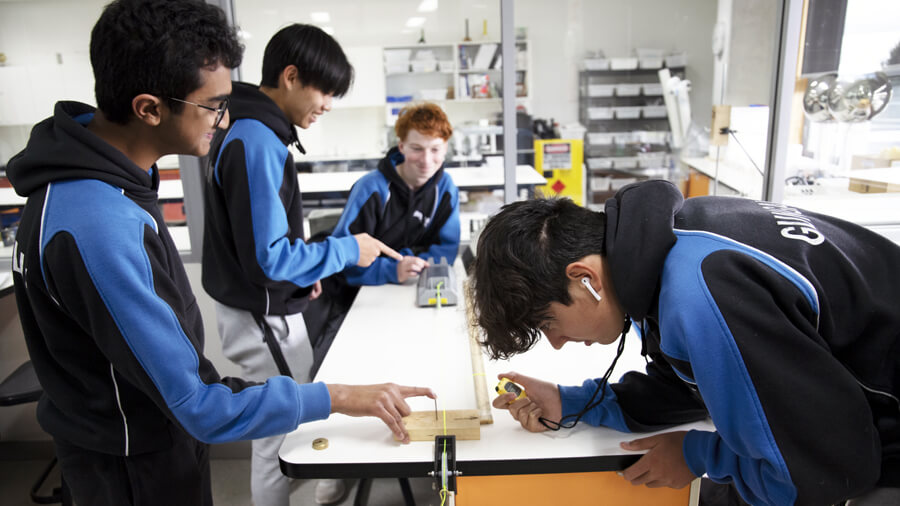
A science course that explains how the universe works, from motion and forces to electricity, magnets, light and modern physics. Students use experiments, models and data to test ideas and solve problems.
Important: Chemistry students must also be enrolled in at least one of these maths courses: Mathematical Methods, Specialist Methods, Specialist Mathematics.
This course is a good choice for students who:
- like solving problems with maths and evidence
- enjoy practical investigations and working with data
- are interested in engineering, technology, space, or how things work
About this course
Physics uses a small set of laws and models to explain a wide range of phenomena—from the very small to the very large. Students learn key ideas and models (including classical mechanics, atomic models and electromagnetism), and they investigate how energy links many different systems.
As students progress, they also explore modern ideas such as relativity, quantum theory and the Standard Model, and learn how new evidence can change or improve scientific theories.
Pathways
Physics can support pathways into areas such as:
- engineering and technology
- renewable energy and new materials
- communications and transport safety
- medical science, climate science, and space science
Units in this course
Students complete 2 units for a Minor or 4 units for a Major.
Linear Motion and Waves
This unit explores how forces affect motion, and how waves transfer energy (including sound and light).
Students will:
- investigate motion using Newton’s laws, graphs and equations
- explore wave behaviour and use wave and ray models to explain real phenomena
Thermal, Nuclear and Electrical Physics
This unit explores heating and thermodynamics, radioactivity and nuclear reactions, and how energy moves through electrical circuits.
Students will:
- investigate heating processes and nuclear physics using evidence and models
- analyse electrical circuits and calculate current, voltage, resistance and power
Gravity and Electromagnetism
This unit explores motion in gravitational, electric and magnetic fields, and how electromagnetic waves are produced and travel.
Students will:
- model and calculate motion in gravitational fields (including satellites and circular motion)
- investigate electromagnetism and energy transfer in electromagnetic devices
Revolutions in Modern Physics
This unit explores the physics that explains very fast motion and very small objects, including relativity, quantum theory and particle physics.
Students will:
- investigate key evidence behind modern theories (like relativity and wave–particle ideas)
- use models and maths to explain modern technologies and scientific discoveries